
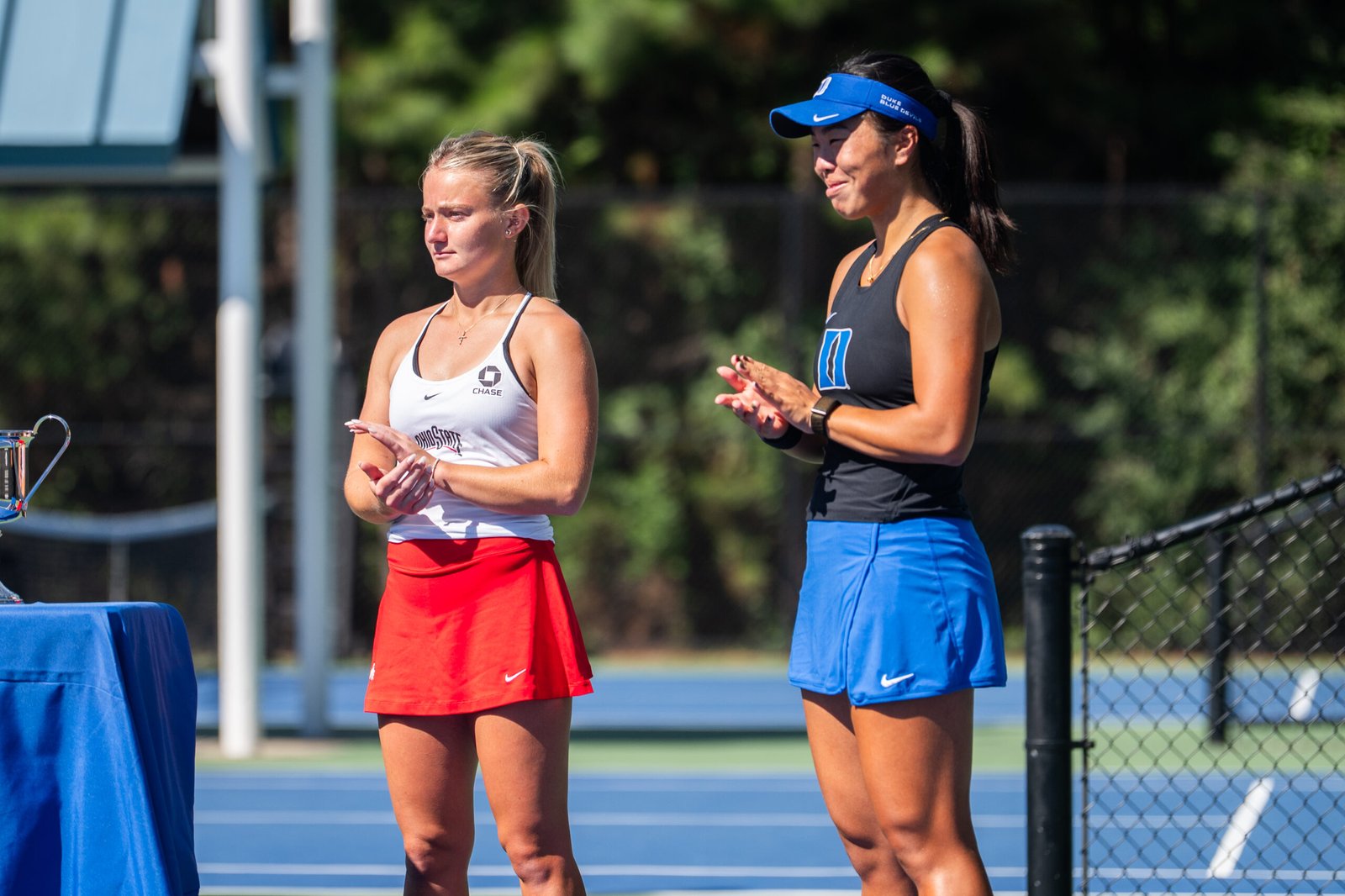
Photo by Erez Aidlin
The top seeds for the NCAA singles and doubles championships were released this evening as we inch closer to the NCAA Men’s and Women’s Individual Championships, taking place Nov. 17-22.
The seeding was mostly determined by World Tennis Number (WTN), but other factors were used including strength of schedule, head-to-head results and record against common opponents, per Colette Lewis. That compares to last year where the ITA’s unpublished rankings were used for the basis of seeding, according to ITA CEO David Mullins, against the wishes of the ITA.
A seeding system that ignores your best player is probably not a good one. Anyway, we’ve got a new system, so here are the seeds for 2026 (From ZooTennis):
WOMEN:
Singles:
1. Mimi Xu, Duke
2. Amelie Van Impe, SMU
3. Lexington Reed, Texas A&M
4. Luciana Perry, Ohio State
5. Nao Nishino, Ohio State
6. Rose Marie Nijkamp, Texas
7. Kaitlyn Carnicella, South Carolina
8. Emma Dong, Georgia
9-16, alphabetical:
Irina Balus, Duke
Sophia Cisse-Ignatiev, Ohio State
Arina Malygina, Oklahoma State
Alexis Nguyen, North Carolina
Salakthip Ounmang, Oklahoma
Bella Payne, Georgia
Katie Rolls, Virginia
Lavinia Tanasie, NC State
Doubles:
1. Teah Chavez and Sophia Cisse-Ignatiev, Ohio State
2. Rose Maris Nijkamp and Carmen Herea, Texas
3. Lexington Reed and Kristina Paskauskas, Texas A&M
4. Patricija Paukstyte and Bella Payne, Georgia
5-8, alphabetical by school
Sara Svetac and Lily Taylor, Arizona State
Emma Dong and Ranah Stoiber, Georgia
Luciana Perry and Flora Johnson, Georgia
Salakthip Ounmuang and Zoie Epps, Oklahoma
MEN:
Singles:
1. Roger Pascual, TCU
2. Keegan Rice, Virginia
3. Luca Preda, Virginia
4. Theo Papamalamis, Texas A&M
5. Aidan Kim, Ohio State
6. Dominick Mosejczuk, Wake Forest
7. Nikita Filin, Ohio State
8. Tomasz Berkieta, Texas
9-16, alphabetical
Luciano Ambrogi, Oklahoma
Nicolas Arsenault, Kentucky
Rodrigo Fernandes, Cornell
Toby Kodat, NC State
Bruno Kuzuhara, Clemson
Johan Rodriguez, Oklahoma
Andres Santamarta, Virginia
Ilia Snitari, Texas A&M
Doubles:
1. Nikita Filin and Brandon Carpico, Ohio State
2. Aidan Kim and Bryce Nakashima, Ohio State
3. Albert Pedrico and Cooper Woestendick, TCU
4. Noa Vukadin and Viktor Markov, Clemson
5-8, alphabetical by school
Chris Xu and Niels Ratiu, North Carolina
Mortiz Kudernatsch and Pietro Pampanin, Ole Miss
Lasse Poertner and Aleksa Pisaric, Pepperdine
Paul Barbier Gazeu and Charlie Robertson, South Carolina
Points of interest/contention
You can tell that the committee strongly favored WTN for their seeding because most of the older newcomers who qualified are represented, even the ones that arguably didn’t have the best fall of college tennis. Namely, Toby Kodat (NC State) who got through via the East Sectional quarterfinal playoff. Though Kodat did take down No. 5 Devin Badenhorst (Baylor) in his first college tennis match, his following results didn’t scream “top 16 player in college tennis.” Also, look at Luciano Ambrogi (Oklahoma), who only played the fairly weak Central Regional and went 5-0 to qualify. 20-year-old freshmen Luca Preda (Virginia) and Tomasz Berkieta (Texas) earned seeds, No. 3 and No. 8 respectively.
It’s also pretty curious that Mimi Xu (Duke) earned the No. 1 seed over Luciana Perry (Ohio State) despite the fact that Perry dominated their match in the ITA All American Championship final in September 6-2, 6-1. How can this data point be ignored if theoretically, you are willing to consider it? Perry also picked up three wins versus players in the top eight at All Americans, although so did Xu.
Perry at least earned the No. 2 seed with her play this fall. But that’s not how the committee sees it without head-to-head results for the other players, as well as WTN being the main determining factor. No. 11 Amelie Van Impe (SMU) and No. 60 Lexington Reed (Texas A&M) are both seeded ahead.
This is the NCAA Collegiate Tennis Singles Championship played on a college campus against fellow college players. ITA results should be a main factor in determining seeding, and Van Impe lost to Xu, who lost to Perry. The primary determination should not be a bunch of tournaments played on clay in Belgium over the summer.
This devalues college tennis. On the men’s side, they did factor in No. 80 Roger Pascual Ferra’s (TCU) meteoric rise this fall as he swept through the All Americans field without dropping a set, giving him the No. 1 spot over No. 6 Keegan Rice (Virginia). How much of a difference in WTN justifies ignoring direct evidence of superiority?
Another example of under-looking college tennis results is No. 36 Ekaterina Ivanova (Wisconsin) falling outside of the seed range. She qualified once during All Americans, reaching the quarterfinal where she lost to Perry, and then qualified again at the Midwest Regional, going 8-1 this fall season.
The bigger concern is that prioritizing WTN further disincentives players from playing in fall tournaments. On one hand, it seems like the fall tournaments have already been reduced to a vehicle for players to qualify for NCAAs, and once they do, they put all their energy into pro events. Some of the best players aren’t even trying to qualify for NCAAs. But who can blame them? They are pursuing a professional career. At the same time, if you have the ability to reward players for competing in more fall tournaments, you should do it.
Another snub in my book is No. 10 Mia Slama (NC State), whose WTN is not near good enough to be top 16, but has had solid fall results with three wins over players in the field including No. 7 seed Kaitlyn Carnicella (South Carolina), while her only loss came to No. 5 seed Nao Nishino (Ohio State). To be fair, Slama’s UTR is sixth-best among qualifiers.
The NCAA started using WTN to avoid a major error such as the one made last year with defending champion Michael Zheng going unseeded. But the prioritization of WTN seems to be adding to the forces making fall events more irrelevant.







3 Comments
You ask “how can this point be ignored” but it wasn’t. It’s a precise formula that decides the seedings. There is no voting or subjectiveneas to it. Nobody gets to vote to decide to put one player ahead of another it’s just math, that’s it.
UTR is still King. Why won’t they use some combination of UTR and college results?