
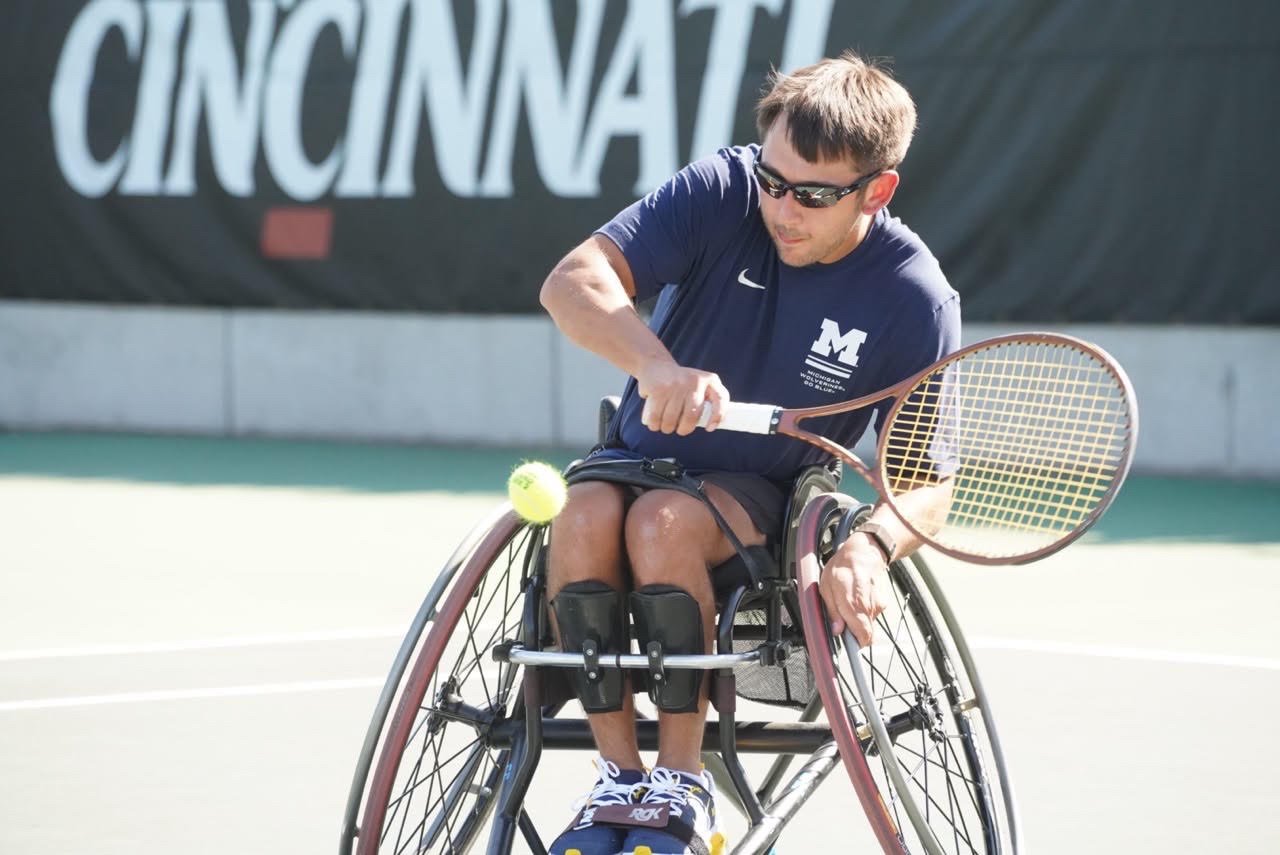
Courtesy of Jacob Wald
Once again, the Intercollegiate Tennis Association will be hosting the College Wheelchair Tennis Individual Championships semifinals and finals alongside the able-bodied NCAA Men’s and Women’s Individual Championships this fall.
Working with the USTA, the ITA has increased its footprint in wheelchair tennis and helped integrate the wheelchair community into the broader atmosphere of college tennis — something that should be met with great praise. Michigan fifth-year Jacob Wald will be competing in the event, looking to redeem himself after losing in the semifinals last year.
For Wald, the ITA’s increased involvement in wheelchair tennis has led to greater recognition for athletes who have been historically overlooked.
“It can’t be overstated the amount of exposure that that gives you,” Wald said. “It does a lot to be a wheelchair athlete and to see yourself being posted on these huge pages that you grew up looking at… After putting in the work, it feels like you’re being rewarded for it and seeing yourself in places where you grew up watching.”
Wald was diagnosed with a rare autoimmune disease called Transverse Myelitis at 11-years-old, affecting his spine and mobility. For a while after his diagnosis, Wald was reluctant to get involved with adaptive sports.
That changed though after Wald got to University of Virginia.
“I went through my whole first year there without doing anything with adaptive sports,” Wald said. “And then at the very beginning of my second year, someone that was on the wheelchair tennis team saw me walking around campus with my crutches. And they said ‘hey, you should come out and try tennis.’ So I did, and I swore that I was like not going to touch the wheelchair. I didn’t want anything to do with it. But I got out to practice. They got me in the chair. I hit a couple balls and I just kind of fell in love with it from there.”
Wald played for three seasons at Virginia before graduating, and is now pursuing his masters in computer science at Michigan, continuing his education and his competitive college tennis career. In a short time, he has excelled in the wheelchair tennis space.
“Disability can be acquired at any time in your life, so most adaptive athletes don’t have the traditional path of starting the sport when they’re four years old and then developing from there,” Wald said. “So for me, I was only 3 years in, but I knew I wanted to give more at the highest level. I wanted to give myself a chance to achieve more.”
Wald spoke about his general experience in wheelchair tennis and what last year’s championship at Lake Nona meant for him.
“It’s a very common experience for adaptive athletes to find it easy to feel like an impostor in their sport,” Wald said. “That’s for a lot of reasons. The space is small and a lot of universities are really trying and really doing a good job of integrating and making it better. But, it’s still lagging behind in a lot of areas.”
“When we were at Orlando, going into that campus and going into the courts and the facility and seeing all these DI athletes, for the first time, I felt like a DI athlete. I’ve been training like a DI athlete for the last four years. That was the moment where I felt like a DI athlete. And it’s all about inclusivity, right? I mean, being next to all those schools, seeing how serious it is, seeing all the coaches, seeing all the athletes, seeing the talent that was there. I mean, it was fantastic.”
ITA CEO David Mullins spoke about the ITA’s increased role in wheelchair tennis as the organization works more with the USTA.
“This has evolved over time, something we really didn’t have much involvement in until about three or four years ago, and we started working more closely with the USTA,” Mullins said. “We identified that they were doing a lot in the collegiate wheelchair space, and in order for that division to make any inroads with the NCAA, that it needed to have a lot more structure and governance.”
“There was a lot of work done early on. And we’re continuing to progress, but the last few years, we’ve been able to have the semifinals and finals of the wheelchair championships, and the top players compete along with the able bodied players at the DI national championships.”
As far as storylines go, the clear favorite for the event is two-time defending champion, No. 1 Francesco Felici (Alabama). Alabama has been a bit of a powerhouse in wheelchair tennis, Wald says.
“They had Thomas Venos, who’s No. 37 in the world, the No. 1 Canadian,” Wald said. “And even now, they have really good athletes. They have the number one player in college right now, Francesco [Felici]. He’s an international student from Italy. And that’s another thing we’re starting to see in collegiate tennis now too, for wheelchair, is we’re getting international athletes, people that are coming from Europe, from other countries to compete for these programs, which is really, really cool. And we’re now kind of getting into the space where there’s enough athletes coming in and enough talent coming in where the talent is spread out a lot more.”
Michigan is one of the programs challenging Alabama’s dominance as the Wolverines won the title in 2026. Two of the semifinalists, Wald and Ben Viana Silvetti, come from Michigan. The other competitor will be No. 2 Max Wong out of Arizona.
Tennis’ unique structure is conducive to a good adaptive product, and through the efforts of the ITA, it will once again be on display for college tennis fans next week. What other sport offers this kind of inclusivity?
The NCAA Men’s and Women’s Individual Championships will take place Nov. 17-22.