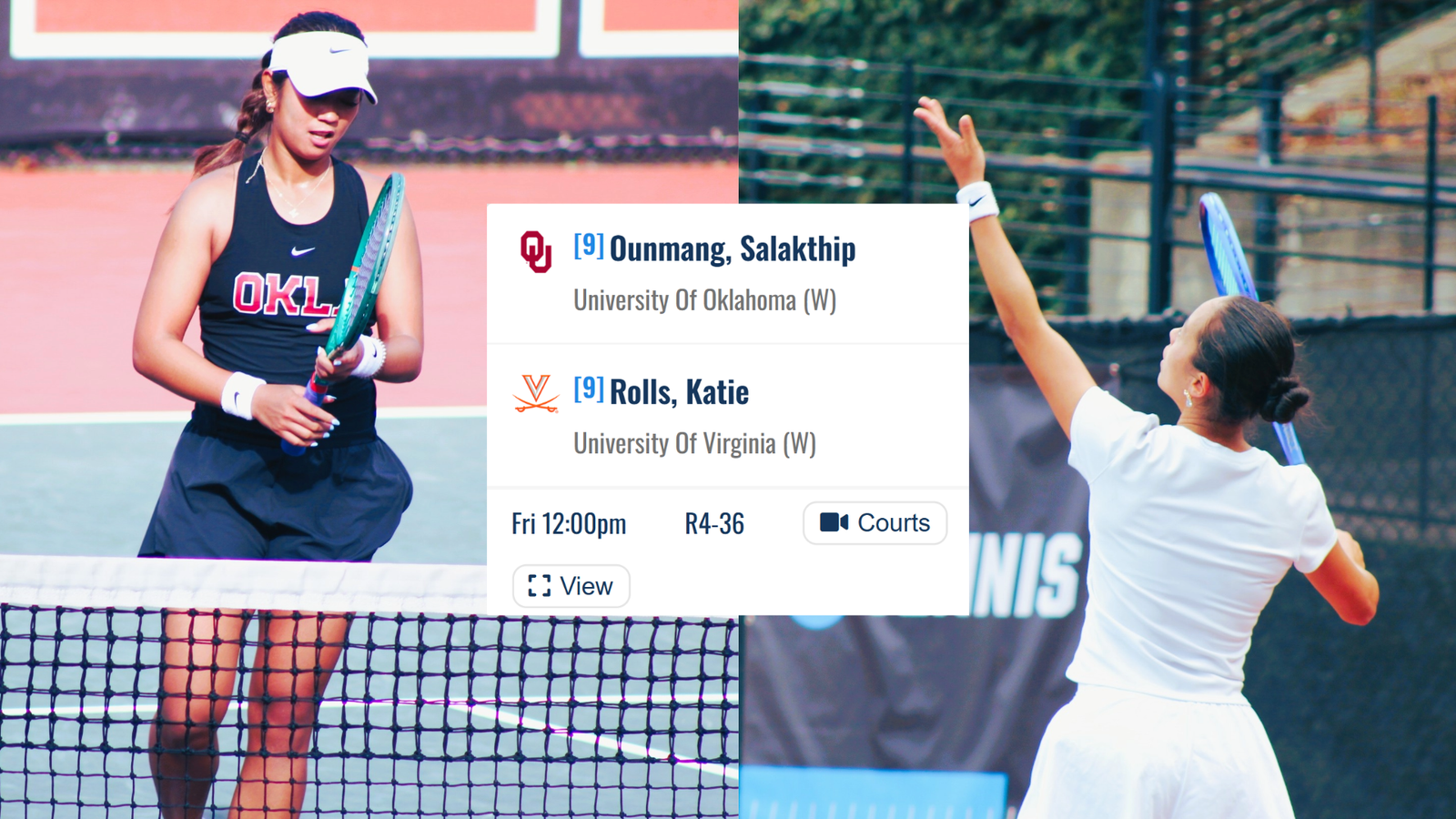
On Monday night, as I sent my NCAA Tournament preview through production at The Michigan Daily, I received the same question in a few rounds of edits: what was up with me calling Virginia’s Katie Rolls a “9-16 seed”?
As I explained to them, the seeding for the NCAA Tournament stops being specific after the top 8. The second tier of seeds are simply a group, without any specification. The reaction that I was met with — which I agree with — is that this whole concept is pretty dumb.
First of all, it just makes everything look clunky. “No. 8 seed Rodrigo Fernandes” looks a lot cleaner than “No. 9-16 seed Oliver Ojakaar”, and in the ITA draws, eight players are listed with [9] next to their name, which adds to the confusion for anyone who doesn’t know about the 9-16 concept.
On the topic of the draws, the 9-16 seeds make the draws look timid. With constant seeding controversy surrounding this tournament and other individual college tennis tournaments, the message I get when I see these ambiguous 9-16 seeds is that the NCAA simply wants to avoid more controversy, which is the easy way out. That, or they’re just being lazy and stopping at eight, which I certainly hope isn’t the case but very well could be considering college tennis is low on their priority list.
The NCAA Tournament is meant to be the pinnacle of college tennis, showcasing the very best it has to offer. If the draw can’t bother to at least look official, it takes away from the prestige of the tournament.
I’m far from being a casual tennis anything at this point, but consider the view of the casual fan, who may not know, say, Lavinia Tanasie or Arina Malygina. Putting them on the exact same level even though they’re both seeded simply isn’t helpful for them to learn more about how they stack up against the rest of the competition. It also messes up the sections — in professional tennis, the seeds No. 9-12 play seeds No. 5-8 in the round of 16 while seeds No. 13-16 play seeds No. 1-4. Instead, though, these round of 16 matchups are completely arbitrary, and a player who may have been the No. 9 seed could end up having to play a top seed far earlier than they should.
Ultimately, I just don’t understand why this is the convention. I can’t see any benefits of the blanket 9-16 seed (or the 5-8 seeds in doubles, for that matter) and it just doesn’t seem that inconvenient to order these eight players. To prove that point, I’ve put the 9-16 seeds in order, trying to emulate the way seeds were made in the first place: going largely by WTN and taking fall results into account. Frankly, it wasn’t that hard.
Men’s Singles:
9. Andres Santamarta Roig (Virginia)
10. Oliver Ojakaar (Texas)
11. Nicolas Arsenault (Kentucky)
12. Ilia Snitari (Texas A&M)
13. Bruno Kuzuhara (Clemson)
14. Johan Rodriguez (Oklahoma)
15. Luciano Ambrogi (Oklahoma)
16. Toby Kodat (NC State)
Women’s Singles:
9. Salakthip Ounmuang (Oklahoma)
10. Lavinia Tanasie (NC State)
11. Bella Payne (Georgia)
12. Katie Rolls (Virginia)
13. Sophia Cisse-Ignatiev (Ohio State)
14. Irina Balus (Duke)
15. Alexis Nguyen (North Carolina)
16. Arina Malygina (Oklahoma State)