Courtesy of Nikola Parichkov
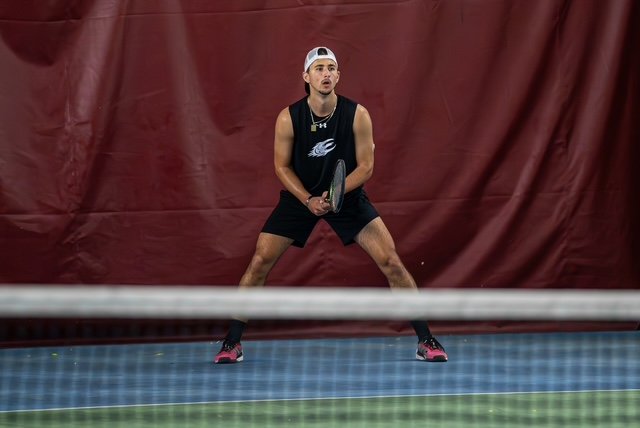
Facing a Type 1 diabetes diagnosis late in his junior tennis career, Nikola Parichkov didn’t know if his playing days were through.
Three years later, he’s found a supportive community, was recognized with the Novo Nordisk Donnelly Scholarship at the US Open, played for a national-championship winning team and secured an NIL partnership with Dexcom, the leading biotech company in the insulin regulation industry.
“I was going into my senior year of high school and talking to college coaches when I noticed my health declining over a few months,” Parichkov said. “I was getting tired, trying to gain weight by going to the gym and eating a lot, but I kept losing weight. I ended up losing about 35 pounds before I was diagnosed. It was a tough two months. I was very close to hanging up the racket.”
Parichkov had looked to parlay his burgeoning junior career into a successful college tennis and pro career, but his new diagnosis initially became a barrier as he looked to navigate the mental aspect of having to manage his blood sugar and his matches. Luckily, he had someone to look up to as a role model.
Parichkov cited Alexander Zverev, the recent US Open and French Open champion, as an inspiration due to the German’s own experience navigating the tennis world with diabetes. Zverev got an early diagnosis at three years-old, but kept his diagnosis private due to the stigma associated until 2022.
“One of the biggest things for me when I was trying to find my feet again after I got diagnosed,” Parichkov said. “I saw an article about Alexander Zverev, and he had recently, at the same time I was getting diagnosed, became more public about his life with diabetes. He’s had it since he was about three years-old. And so that kind of motivated me. To just keep my head in and focus on what I’ve been doing pretty much my whole life.”
The Florida native stuck with it and ended up getting connected with Wake Forest men’s tennis head coach Tony Bresky, and was on campus in Winston-Salem that fall. Eight months later, he was holding the national championship trophy, going 2-0 in singles that spring, though unable to get much court time on a stacked Wake Forest squad.
In search of more playing time, Parichkov transferred to Elon, and contributed to the Phoenix’s Coastal Athletic Conference championship. More than that, he sought an opportunity to champion the diabetic community and help people through the difficult situations he faced.
“[Dexcom has] given me a platform and the opportunity to mentor others,” Parichkov said. “Since posting about Dexcom, I’ve had parents reach out to learn how I manage diabetes and what they can take away from my experience.”
“That’s what I’ve appreciated most. I want to make a difference, and while building something like [Alexander] Zverev’s foundation would be difficult, this is a huge step toward potentially doing something like that one day.”
Dexcom produces a continuous glucose monitoring (CGM) system worn on the patient’s arm that tracks glucose levels and displays data via Bluetooth on a connected smartphone. Instead of having to prick their finger and manually test their glucose levels, patients just refer to their device and adjust their sugar intake accordingly, making it easier to manage their levels.
For Parichkov, the diabetic community became a place in which he could thrive, outside of just athletics.
“I’ve had my G7 just sitting there showing when I’m in like the cafeteria or something,” Parichkov said. “And I’ve had some people come up to me and they’re like, ‘hey, I see the Dexcom, you know, we have this group, you know, we meet once a week be it’d be cool if you want to join, meet other people with diabetes’, stuff like that.” So I did do that at Wake Forest.”
This season marks the second year that Parichkov has been a part of the Dexcom U program, having an NIL partnership with the biotech company along with 26 other college athletes.